Remembering Lee Kuan Yew - Thank you - The nation with you in your final journey - See u in heaven

Remembering Lee Kuan Yew - Thank you - The nation with you in your final journey - See u in heaven
Presented to you by Property Smart Investor- A Real Estate Online Education and Discussion

Monday, 24 September 2018

Revision to the Balcony Bonus Gross Floor Area (GFA) Scheme for Private Non-landed Residential Developments to Promote Higher Construction Productivity – Changes to Phase Two Conditions


Revision to the Balcony Bonus Gross Floor Area (GFA) Scheme for Private Non-landed Residential Developments to Promote Higher Construction Productivity – Changes to Phase Two Conditions

  Published: 09 December 2014
Circular No : URA/PB/2014/27-DCG, BCA 104.1.2
Our Ref : DC/ADMIN/CIRCULAR/PB_14, BCA ID
Fax : 6227 4792 (URA)
6325 4800 (BCA)

CIRCULAR TO PROFESSIONAL INSTITUTES

Who Should Know:
Building owners, developers, architects and structural engineers

Effective Date: 
With effect from 9 Dec 2014 to 31 Oct 2018

This circular should be read together with the following circulars:
  1. URA’s Circular No: URA/PB/2009/03-DCG dated 29 April 2009 on “Framework for Managing Bonus Gross Floor Area Incentives”, specifically on the overall 10% bonus GFA budget; and
  2. BCA and URA’s Joint Circular No. BCA 104.1.2 URA/PB/2013/10-DCG dated 2 Sep 2013 on “Revision to the Balcony Bonus Gross Floor Area (GFA) Scheme for Private Non-Landed Residential Developments to Promote Higher Construction Productivity".
  1. The revised Balcony Bonus GFA scheme was implemented on 1 Nov 2013 to encourage the industry to adopt more productive construction solutions. It also aimed to reward developers who make the extra effort to strive for higher buildability.
  2. Since its implementation, BCA and URA have received encouraging response in support of the productivity drive. To further raise construction productivity, BCA has amended the Building Control (Buildability) Regulations to require higher minimum Buildable Design Scores as well as mandatory use of drywalls for all internal dry areas and Prefabricated Bathroom Units (PBUs) for selected developments with effect from 1 Nov 2014 (See BCA’s new Circular No. BCA APPBCA-2014-16 dated 31 Oct 2014).  With these changes, BCA and URA are updating the conditions of the scheme with immediate effect.
Revised conditions to make use of the Balcony Bonus GFA Scheme
  1. Private non-landed residential developments (including executive condominiums) and the residential component of mixed-use projects1 can apply for the balcony bonus GFA scheme up to 10%, subject to the revised conditions specified in the table below with immediate effect.

    Previous ConditionsRevised Conditions
    1. At least 65% of the bathrooms are PBUs1. At least 80% of the bathrooms are PBUs
    2. Achieves a buildable design score that is at least 10 pts above the minimum legislated score2. Achieves a buildable design score of at least 
    a) 90 points for GFA ≥ 25,000sqm 
    b) 87 points for 5,000sqm ≤ GFA < 25,000sqm 
    c) 82 points for 2,000sqm ≤ GFA < 5,000sqm
    3. Uses drywalls for all internal dry areas in the developmentSee note below
    Note : The condition for use of drywall for all internal dry areas is no longer required since drywall is already mandated for all non-landed residential developments under the amended Building Control (Buildability) Regulations.
  2. Where balconies are proposed under the scheme, the prevailing standard guidelines for balconies (e.g. perimeter openness, balcony screening requirements, etc.) will still be applicable.  The Balcony Bonus GFA will not form the new prescribed maximum GPR for the site upon redevelopment.
  3. The requirements for approval of the Balcony Bonus GFA under the scheme, the submission and evaluation process, as well as the consequences of non-compliance as stated in the earlier circular released on 2 Sep 2013 (Circular No. BCA 104.1.2 URA/PB/2013/10-DCG) shall remain the same.
Implementation
  1. The revised conditions will supersede the previous conditions under Phase 2 of the Balcony Bonus GFA scheme and will apply to all new applications for private non-landed residential developments (including executive condominiums) and the residential component of mixed-use projects submitted on or after the effective date2. Only formal development applications (excluding Outline Applications) submitted before the effective date2 which have already been granted Provisional Permission or which will result in a Provisional Permission, will not be subject to the revised conditions under Phase 2 of the Balcony Bonus GFA Scheme2.
  2. We would appreciate it if you could convey the contents of this circular to the relevant members of your organisation. If you or your members have any queries concerning this circular, please do not hesitate to contact BCA’s Mr James Lu at Tel: 6325 5091 (email: james_lu@bca.gov.sg) or URA’s DCG Enquiry Line at Tel: 6223 4811 (email: ura_dcd@ura.gov.sg). For your information, the past circulars to the professional institutes are available from our BCA, URA and CORENET websites in the links http://www.bca.gov.sg,  http://www.corenet.gov.sg/einfo/ and http://www.ura.gov.sg .
Thank You. 

ANG LIAN AIK
GROUP DIRECTOR
CONSTRUCTION PRODUCTIVITY CENTRE
BUILDING & CONSTRUCTION AUTHORITY

HAN YONG HOE
GROUP DIRECTOR
DEVELOPMENT CONTROL
URBAN REDEVELOPMENT AUTHORITY
Join URA's mailing list to get the latest updates on current and future plans and developments around Singapore. Click here to subscribe.
 ___________________
1 Applicable to all new building projects with GFA of 2,000m2 or more.
2 Development applications submitted before the effective date resulting in an Advice or Refusal of Written Permission (RWP) will be evaluated based on the revised conditions under Phase 2 of the Balcony Bonus GFA scheme upon resubmission after the Advice or RWP.


Strata void areas in condos: How to avoid ‘paying for air’


Strata void areas in condos: How to avoid ‘paying for air’

JUNE 12, 2018
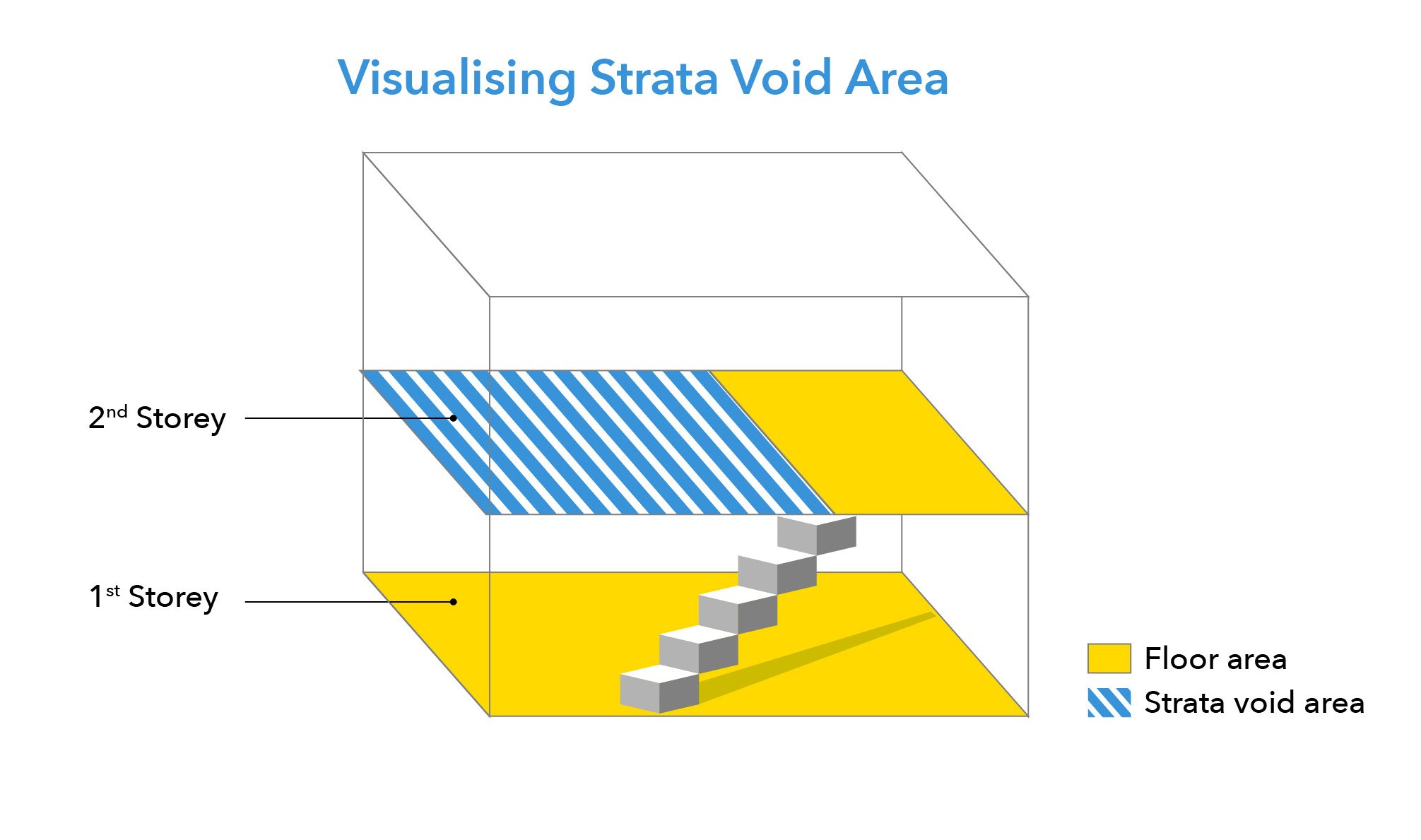
When The Straits Times ran the article Are you ‘paying for air’ when you buy a house? on 11 June 2018, it highlighted an unknowing buyer who was quoted a much higher price than the gross floor area for a new launch condo unit. The article’s intention was to inform buyers of strata void area, which is defined as the void space that is included in the total saleable floor area of the strata unit (e.g. condo unit), as our illustration of a 2-storey unit below shows:
Strata-void-area-diagram
Per square foot, a strata void area may be 30 to 50% the price of actual floor area. This means that a condo unit with strata void area will list a lower psf price than a unit without. This may create some confusion in buyers who don’t immediately discern that a particular unit’s listed psf price is cheaper solely because of its strata void area, example below:
Assuming everything else is the same (e.g. rooms layout, facing, floor),
Unit A: 2,000 sq ft (inclusive of 500 sq ft strata void area) at $1,300 psf priced at (2,000 x $1,300) = $2,600,000
Unit B: 1,500 sq ft (with regular ceiling height throughout) at $1,600 psf priced at (1,500 x $1,600) = $2,400,000
To help buyers identify strata void areas without confusion, we’ve created a simple and straightforward guide. Bookmark this for the next time you’re viewing or buying a property — be it a strata condo or landed unit — so you’ll never be uncertain about “paying for air”.

Do: Pay attention to the floor plan

Since 2014, the Urban Redevelopment Authority (URA) has mandated that developers disclose the breakdown of the different areas in the unit, including any strata void areas, in sales documents such as the floor plan.
An example:
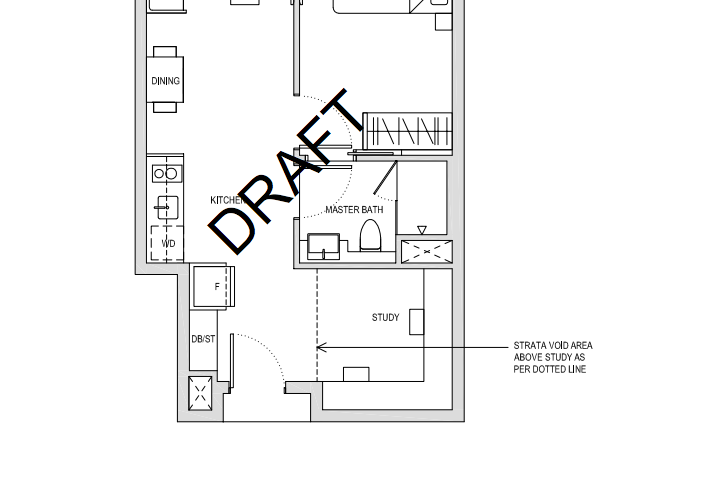
Strata Void Area Floor Plan
The strata void area is clearly marked out in this project’s floor plan.
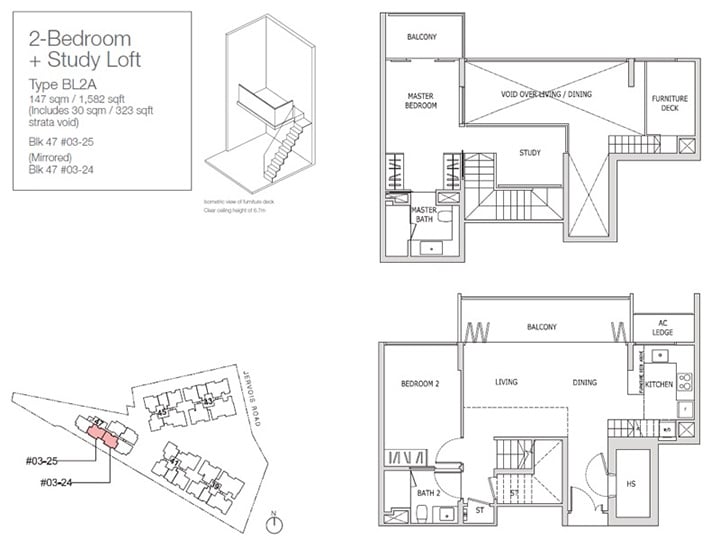
Another example:
Strata Void Area Example 2
The strata void area for this unit is stated in different way. Can you find it?
In other words, developers have an obligation to be transparent to the prospective buyer. Note that although the strata void areas are marked out in the examples above, the prospective buyer should go one step further and clarify the exact boundaries and area of the strata void area with the sales rep.

Do: Read sales documents carefully

Before the buyer pays the booking fee for his desired unit, the developer is required by law to provide him/her with the details of the unit and the housing project, such as the description and estimated areas of all spaces. This includes the void area, if any.
There’s more. The developer must obtain the buyer’s written confirmation of receiving such information. Buyers are understood to have read this information carefully before paying the booking fee.
So, regarding strata void areas, can buyers somehow argue that they were misled in any way? Let’s look back to 2014 when a couple took a executive condominium (EC) developer to court. The couple alleged that the penthouse they paid a $56,050 option fee for was smaller than what they were led to believe.
In its defence, the developer argued that there had been no misrepresentation. This was because the Option to Purchase signed by the couple had clearly stated that the total saleable floor area took into account the air-conditioner ledge, roof terrace and the void area of the unit. The couple eventually dropped the suit.
This case shows that, at the very least, buyers are expected to recognise if any void area is specified on the developer’s sales documents (e.g. Option to Purchase, Sales & Purchase agreement) before they sign. The actual wording might be something like this:
(a) Floor area refers to the estimated area of the whole apartment, inclusive of the area of the air-conditioner ledge and voids (where applicable).
(b) Internal floor area refers to the estimated area of the apartment computed based on the centre line of the apartment wall.

Do: Obtain the necessary certificates (if the property is not a new launch)

If buying a resale condo unit, it might be harder for buyers to notice strata void areas given there might be a lack of documents from the outset. So, buyers should do the following instead before paying the option fee (information courtesy of the Singapore Land Authority, SLA):
Buyers who are buying an uncompleted property in the sub-sale market (i.e. not directly from the developer) should ask the seller for a copy of the Certificate of Strata Area from the seller before paying the option fee. The certificate would state the floor area of the property, including void areas, if any.
Before buying a completed strata unit for which a Subsidiary Strata Certi cate of Title (SSCT) has been issued by SLA, buyers can buy a print-out of the SSCT to check the area of the strata unit and also check if the area of the strata unit includes any Void Areas. For SSCTs issued on or after 1 August 2012, Void Areas, if any, will be shown in the SSCT.
Before buying a completed strata unit, buyers can buy the Strata Certi ed Plan (CPST) for the strata unit from SLA’s Integrated Land Information Service (INLIS) to check if the unit interested in is affected by Void Areas.
If all this sounds complicated to you, that’s the cue for you to engage a CEA-registed Buyer’s Agent to help you with your home-buying journey.

How high must the ceiling be for it to be considered as strata void area?

This is where ambiguity can set in as the practices differ from one developer to another, and from one project to another. Generally, loft units with ceilings that aren’t high enough to allow standing on the loft deck do not count void areas. On the other hand, units with a “double volume” space as part of the strata area, such as a penthouse with a 4.7 metre floor-to-ceiling height, will have void areas factored into the total cost.
An important note for strata landed houses. If there’s an airwell or similar feature, buyers might end up paying for several levels of void areas between the ground floor and the roof.Investors of industrial and commercial spaces should also take note of strata void areas as tenants typically only take floor space into account when renting these spaces.
A good rule of thumb is, if you view a unit and you’re not comfortable when something is classified as a strata void area, just walk away.


Private Enclosed Spaces (PES): Are you paying too much for them?


Private Enclosed Spaces (PES): Are you paying too much for them?

JUNE 10, 2018
A Straits Times report in 2017 revealed that Singapore’s home buyers pay an estimated $780 million for air-con ledges every year. That’s enough money to trade these void spaces for three F-16 fighter jets!
The latest angry buyers are 200 residents in La Fiesta condominium in Sengkang, who have been charged for air-con ledges that are up to five meters long, and take up around nine square meters. That’s the size of a common bedroom in condos nowadays, and buyers are essentially paying for an oversized resting spot for pigeons.
However, it’s not the first time disputes about similar “useless spaces” have occured. Besides air-con ledges, developers have another trick up their sleeve: Private Enclosed Spaces (PES). Here’s what condo buyers need to know about it before they decide to buy a condo unit.

Private Enclosed Spaces (PES) and the Gross Floor Area (GFA) rule: Where is the loophole

The GFA denotes the maximum amount of liveable space a developer can build on a given plot of land.
The Urban Redevelopment Authority (URA) determines what counts as GFA, and what doesn’t. For example, the following Private Enclosed Spaces (PES) do not count as part of the GFA, and hence developers don’t have to worry about them taking up strata space (i.e. space that buyers actually pay for in a condo).
  • Covered link-ways, pavilions, and sheds, such as the gazebo in the communal garden
  • Basement diaphragm walls, which are only important if you don’t want the house to collapse
  • Cladding or curtain walls, a superficial layer that conceals the front of the real thing. Like a fake brick cladding, or Donald Trump’s charity organisation
  • Any leftover space in the carpark, although storage, loading platforms, and lifts still count as part of the GFA.
  • Covered public walkways
  • Covered public concourse
  • Fake roof to conceal unsightly rooftop equipment
  • Utility rooms, such as pump rooms for swimming pools, or chambers for power cables
  • Roof-top or other uncovered landscape gardens, tennis courts, swimming pools
  • Ledges for air conditioners and planters. This is where the above-mentioned problem lies
  • Space for equipment that has to be mounted or permanently put in place, such as a water tower
So air-conditioner ledges are not part of the GFA, which means developers can build them the size of a football field if they want. It still doesn’t take up the spatial limit they have to build more units.
However, as mentioned, developers can charge buyers for the space of the ledge. The reason: air-con ledges solely serve individual units, they are considered part of the strata area, and are therefore chargeable to the buyer. At a price of $900 per square foot, for example, a nine square meter ledge (approx. 97 square feet) will set you back $87,300. That’s pricey for something that holds two air-con compressors and bird poop.

This isn’t the first time we’ve seen this kind of shenanigans though

Back in 2013, the URA had to revise rules regarding Private Enclosed Spaces and private Roof Terraces (RTs). Before that, PES and RTs were not counted as part of the GFA as well.
The result, as you can see in the linked document, was some developers losing their minds and creating giant PESes and RTs. It was good money, because it’s cheaper to build this kind of space than indoor space (just make the top of the unit flat, or throw in a balcony with giant planter boxes, and suddenly the developer makes $150,000 more per sale).
So the URA clamped down on the exploitation of these spaces for profit (with the exception of shared, or communal RTs, which are still not part of the GFA).
private enclosed space balcony

What about balconies, which counts as GFA?

If you wonder why so many condos have disproportionately oversized balconies when the dining room can barely fit two people and their toy poodle, it’s because URA states that GFA of the balconies “is allowed to be computed over and above the Master Plan control, subject to a cap of 10%.” In layman terms, developers have bonus GFA just for balconies, so they happily build them as part of their units because one, it’s the cheapest part of an apartment block to build and, two, they get to charge you for it.
The truth is, while many buyers love balconies, they half-wish they can switch it to a bigger indoor living area. So to make the best decision when buying a new launch condo, ask yourself whether the balcony is actually laid out in a functional shape and configuration, or if it suits your plans (e.g. the balcony as just a lounge area vs. an entire dining area).

Will we see air-con ledges become part of the GFA?

This may not be as common sense an issue as it seems. You see, including the air-con ledges in the GFA means some* developers might be incentivised to build them as narrow as possible. That’s going to be problematic five to 10 years down the road, when your air-con does break down and you need to find a technician who also doubles as a parkour expert.
What’s probable is that air-con ledges won’t count as part of the GFA, but will remain subject to regulations. For example, URA prescribes that air-con ledges be no wider than a metre, and might in future issue some guidelines on the right size (or range of sizes) for air-con ledges.
(*Not all. High-end developers don’t bother with GFA tricks too often, for the same reason Mercedes won’t use a cheaper car radio to con you out of $50. They’ll tell you that it’s beneath their architects.)

But I don’t want to pay for air-con ledges!

You can’t get out of paying air-con ledges, but you can tell when you’re paying too much. At the condo’s sales office, the developer is required to answer all your questions about which PES or ledge is used for what. While viewing the showflat, also peer out of the windows and yard to see if the air-con ledge, for instance, is clearly represented as per the floor plan.
For the sake of reference, most air-con ledges should be about three to five square meters (approx. 32 to 54 square feet), and will take up to 3% of the total floor space of your unit, no matter its size.


What is Gross Floor Area (GFA), Strata Area, Build-up Area and Build-in Area


What is GFA?

GFA = Land Size (Plot size) x PR (Plot Ratio)

Gross floor area (GFA) measures the bulk and intensity of a development for the purposes of plot ratio control and computation of development charge. Using this GFA concept, the owners or developers are free to determine how much neutral areas they want to provide in their buildings.

All covered floor areas of a building, except otherwise exempted, and uncovered areas for commercial uses are deemed the gross floor area of the building for purposes of plot ratio control and development charge. The gross floor area is the total area of the covered floor space measured between the centre line of party walls, including the thickness of external walls but excluding voids. Accessibility and usability are not criteria for exclusion from GFA

URA Gross Floor Area Handbook
URA Gross Floor Area Handbook PDF

REVISED GROSS FLOOR AREA (GFA) DEFINITION (URA Circular) PDF

GROSS FLOOR AREA (GFA) VERIFICATION SERVICE (URA Circular) PDF


What is Strata Area or Strata Size?

The word Strata means Share. Many strata units sharing the same Land or Plot.
Only for build up blocks like HDB Flat, Condominium, would use Strata Area.

Strata Area = GFA + All the followings

Strata Area is the size of individual units all add up together. This is where the Developer take advantage of the following to made more money and make than enough profit for themselves.

The following are things included in the Strata Area (Size) that was not included in the GFA when developer bought the land from GLS or En-bloc

* Strata Private Void Area

- Strata void areas in condos: How to avoid ‘paying for air’
- Strata void areas graphic illustration by SLA. Making dollars and sense of void areas in a Strata Development. PDF

* Strata Private Balcony Area (Add 10% of GFA)

-  Bonus Balcony Area. Generally about 10% of the GFA
Revision to the Balcony Bonus Gross Floor Area (GFA) Scheme for Private Non-landed Residential Developments to Promote Higher Construction Productivity – Changes to Phase Two Conditions
Strata void areas are getting more rampant in B1 Industry Building and Private Condo

Balcony generally refers to those located in between ground floor and roof terrace.

* Private Enclosed Space (PES)

Private Enclosed Spaces (PES): Are you paying too much for them?
PES normally refers to Ground floor only

* Strata Private Roof Terrace
Roof Terrace generally located at the highest floor or Penthouses

Generally, the PES and the Roof Terrace are Capped at 10% of GFA (Add 10% of GFA)
The URA has reviewed the guidelines and will now count PES and private RTs for non-landed residential developments as part of the bonus GFA capped at 10% above the master plan control.

* Strata Aircon Ledges Area

Setback of RC and Air-Con Ledges for Landed Housing (PDF)

Close loophole that allows developers to charge for space, say buyers and experts


What is Build-Up Area or Build-In Area?

Build-Up Area or Build-In Area normally can be used interchangeabilly. It is used for Landed Properties only.


Sunday, 4 February 2018

Selling properties after one passing on or died


Applying for a Grant of Probate in Singapore

Last updated on January 8, 2018
When a person passes away and his Last Will is produced, the Executor(s) (and Trustee(s) where applicable), who has been specifically appointed by the deceased in the Will, has to make an Application to the Court for a Grant of Probate.
(Note: Where the deceased did not leave a Will, or the deceased’s will cannot be found, the next-of-kin of the deceased are required to apply to Court for a Grant of Letters of Administration.)
The Grant of Probate is a Court Order which empowers the Executor(s) (and Trustee(s) where applicable) to carry out the instructions in the Will which would include the distribution of the deceased’s assets to his specified beneficiaries.
If the gross value of the Estate does not exceed $3 million, the application should be filed in the Family Justice Courts. If the gross value of the Estate exceeds $3 million, the application should be filed in the Family Division of the High Court.
In the event there is no Executor named in the Will, Section 13 of the Probate and Administration Act states that the Court will allow Letters of Administration with the Will annexed to be granted to the person(s) the Court deems ‘fittest to administer the estate’. More information on such person(s) can be found in the Probate and Administration Act.
The majority of probate applications for wills are non-contentious. However, as the Application involves a large number of documents, it is preferable to seek the assistance of a lawyer. If it is foreseeable that the probate application is contentious, seeking advice from a lawyer is highly recommended.

The Application Process

The lawyer acting for you in the application for the Grant of Probate will bring you through the general stages of the application which include the following steps:- 
Preliminary Step: Preparation of Documents required for the Application
The Family Justice Courts website provides the public with the forms required for an application for the Grant of Probate. The usual documents include the following :-
1. Ex-parte Originating Summons
The first document required is the ex-parte Originating Summons. ‘Ex-parte’ means that there is no other party involved in the application; the Executor(s) is the only applicant.
The Originating Summons may be filled using Form 48 of the Family Justice Court Practice Directions (“FJCPD”). Information required in this form includes the details of the deceased and the applicant(s), and the order requested i.e. “Probate be granted to the Applicant(s)”.
In addition, Form 52 of the FJCPD should be attached to the Originating Summons to certify that a search for any caveat and probate application in relation to the Estate in question has been made, and no prior caveat or probate application has been found.
When you approach a lawyer to act for you in the application, your lawyer will file the necessary electronic forms via the e-litigation portal. The digital copy of the search report summary (or any positive search results of a caveat or prior probate application) will be attached to the originating summons.
2. Statement in Form 51
The second document required is the Statement in Form 51 of the FJCPD.  You will be required to provide certain information in relation to the deceased, his Estate and the applicant(s), such as:
  • The particulars of the deceased, including information about his/her death, and domicile (the country in which the deceased was residing before his death);
  • The estimated value of the Estate (and confirmation as to whether it exceeds $3 million or not);
  • Confirmation that the copy of the Will filed is a certified true copy of the Will (the original Will has to be submitted to the Family Justice Courts for verification);
  • Confirmation that the applicant(s) is an Executor named in the Will;
  • Whether the Application is filed within 6 months from the death of the deceased (and if not, the reason for the delay).
In practice, your lawyer will ask you for the above information before filling in the electronic form on your behalf.
3. Certified true copy of the Death Certificate 
The certified true copy of the Death Certificate has to be submitted to Court so that the Court can verify that the owner of the Estate is legally certified as deceased. If the Death Certificate cannot be produced, the Executor may carry out a search for a Death Record (if he is not able to remember the date of death) or apply for a Death Extract (if he can reproduce the full name, NRIC number and date of death). The said searches can be applied for on the online extracts portal of the Immigration and Checkpoints Authority here.
4. Certified true copy of the Will 
The certified true copy of the Will to be filed should contain the certification “This is a certified true copy of the original Will of [name of deceased] dated [date]” on a cover page attached to the copy of the Will.
After the filing of the above documents with the certified true copy of the Will, the original Will should be submitted to the Probate Counter at the Family Justice Courts by 4.30pm on the next working day. After the Court verifies the authenticity of the Will, the Court will return the Will to the applicant (or his lawyer).
The applicant should ensure that the Will is in English. If the Will was written in another language, the applicant should apply for a translation by the Court translator (your lawyer should be able to help you in this regard). The translator will have to verify the accuracy of her translation in a supporting affidavit.
Exceptional circumstances:
  • Should the original Will be in the custody of a foreign court, a certified true copy of the Will should be submitted in place of the original.
  • If the original Will has been lost, the Probate and Administration Act provides that a draft copy may be submitted instead if it appears that both the draft and final will are identical. However, this situation may be potentially contentious and it is recommended that you seek legal advice.
5. Caveat and Probate Search 
A search of both the record of caveats and record of probate applications has to be made on the day of the probate application. As mentioned earlier, a digital copy of the search report (and results of a positive search, if any) has to be attached to the Originating Summons.
The application may proceed smoothly if there has not been any caveat or or prior probate applications. A positive search will mean that the situation is potentially contentious and legal advice is recommended.

Step 1: Submission of the Main Application

The Main Application involves filing the abovementioned documents in Court. In practice, your lawyer will file the Application electronically using the elitigation portal. An Executor(s) who intends to make the application without assistance from a lawyer will have to do so via the counters at the Service Bureau. More information on the locations of the Service Bureaus can be found here.
After the documents are filed in Court, a provisional probate case number will be created and a checklist of items will be generated. As mentioned above, your lawyer will have to submit the original Will to the Probate Counter at the Family Justice Courts by 4.30pm on the next working day. You will then have to provide the supporting documents as explained below.

Step 2: Submission of Supporting Documents

1. Administration Oath
The Executor (and Trustee) who is applying for the right to administer the Estate has to give an undertaking to the Court that he/she will distribute the Estate and effects of the deceased according to the deceased’s instructions in the Last Will and to account for the same. The Executor will also have to pay the deceased’s outstanding debts using the monies in the Estate. This requirement for the Administration Oath is stated in Section 28 of the Probate and Administration Act.
In practice, your lawyer will prepare the Administration Oath in accordance with Form 54 of the FJCPD. You will then be asked to sign the Administration Oath in the presence of a Commissioner for Oaths, after which the Administration Oath will be filed electronically by way of the checklist on the elitigation portal.
2. Supporting Affidavit
The checklist requires the applicant’s Supporting Affidavit to be filed within a given deadline (usually within two to three weeks from the filing of the Administration Oath). Your lawyer will prepare the Supporting Affidavit in accordance with Form 225 of the FJCPD and you will be asked to sign the Supporting Affidavit in the presence of a Commissioner for Oaths.
The following documents shall be exhibited in the Supporting Affidavit:
  1. Statement (filed and accepted by the Court)
  2. The certified true copy of the Death Certificate and Last Will
  3. Schedule of Assets (please see below)
3. Schedule of Assets
The Schedule of Assets has to be filed in the checklist and also exhibited in the Supporting Affidavit. This is essentially a list of the deceased’s properties in Singapore as at the date of death, as well as outstanding debts (which are secured by mortgage).
You should try to identify all the assets of the deceased i.e. both real estate as well as all other personal property, and an estimated market value of such property as at the date of death.
  • Real estate refers to the deceased’s HDB flat / private property / part-share in a flat or property.
  • Personal property refers to any property other than real estate and may include the deceased’s monies in bank accounts (including fixed deposit accounts and unit trust accounts), stocks and shares, insurance policies (please check if the policies have been assigned), vehicle(s), precious jewellery and items in the deceased’s safe deposit box. This list is non-exhaustive and you should ask your lawyer for more specific advice.
  • It is important to note that monies in the deceased’s CPF Account are not considered part of the Estate. If the deceased made a CPF nomination, his CPF savings will be distributed to his nominees. If the deceased did not make a CPF nomination, his CPF savings will be distributed by the Public Trustee according to the laws of intestacy i.e. to family members who rank according to the rules of distribution expressed in Section 7 of the Intestate Succession Act.
As the Schedule of Assets also requires the deceased’s property outside Singapore to be listed, please let your lawyer have the relevant information.
Once you have confirmed the deceased’s assets, your lawyer will file the Schedule of Assets in accordance with Form 226 of the FJCPD as well as the Supporting Affidavit by way of the checklist on the elitigation portal. Please note that any future amendments to the Schedule of Assets will have to be done by way of a separate application.

Step 3: Hearing in Court

Upon the filing and acceptance of the application and the Administration Oath, the Court will inform your lawyer of a probate hearing date and time. Your lawyer is required to attend the probate hearing on the scheduled date and time, unless the rest of the supporting documents (Supporting Affidavit and Schedule of Assets) are filed and accepted by the Court before the hearing date. In such a case, the Court may vacate the hearing date.

Step 4: Submission of Supplementary Affidavit and Schedule of Assets

If you are not able to confirm the details of the deceased’s assets early in the application process, you may ask your lawyer to write to the relevant financial institutions on your behalf. (As the financial institutions will require an express authorisation by the Executor(s), your lawyer will require you to sign a Letter of Authorisation addressed to each financial institution.)
Given how the Supporting Affidavit mentioned above will still have to be filed within the Court’s deadline, your lawyer will require you to sign the Supporting Affidavit that does not exhibit the Schedule of Assets as yet, so that the same can be filed via the checklist on the elitigation portal within the deadline.
The Court would thereafter grant an “Order-in-Terms” of the probate application based on the Supporting Affidavit (without Schedule of Assets). From this point on, your lawyer will be able to write to the relevant financial institutions to ask them for detailed information regarding the deceased’s outstanding accounts / monies / shares. The financial institutions may take some time to respond to your lawyer.
Once your lawyer receives the relevant information and is able to fill in the Schedule of Assets on your behalf, you will be asked to sign the Supplementary Affidavit in the presence of a Commissioner for Oaths. The Supplementary Affidavit exhibits the complete Schedule of Assets. Your lawyer will file both documents on the elitigation portal. Please note that any future amendments to the Schedule of Assets will have to be done by way of a separate application.

Step 5: Extracting the Grant of Probate

Once the Court accepts the Supplementary Affidavit and Schedule of Assets and further confirms that there are no other documents required*, your lawyer will generally be able to request for the extraction of the grant. A final search has to be made to ensure that there are no caveats lodged against the Estate or any pending application in relation to the same. The search results must be submitted with the request for extraction.
*Note: There is generally no need for the Executor(s) (and Trustee(s)) to sign an Administration Bond, since the deceased had specifically entrusted his Estate to him by way of the Last Will. The requirements are different for applicants of Grant of Letters of Administration.
If all documents are in order and all fees are paid, the Court will prepare and issue the Grant of Probate with the engrossed Schedule of Assets annexed. The electronic copy will be sent to your lawyer via the elitigation portal and a certified true copy of the same should suffice for all purposes. You may also ask your lawyer to request for a Paper Grant with the Court’s red seal. With the Grant of Probate, the Executor(s) (and Trustee(s) where applicable) may commence the management and distribution of the deceased’s assets.
https://singaporelegaladvice.com/law-articles/applying-for-a-grant-of-probate/


The complexity of selling residential property after the owner passes away depends on how the property was held – jointly or as tenants in common.

You will first need to request an updated title search to ascertain how the property is owned and find out whether there are any barriers to prevent a sale (i.e. caveat/notice of claim).
Jointly held propertyIf the property is owned jointly, which is often the case with married couples or if the property is owned by a trust, Transmission by Survivorship will need to be completed.

Any jointly held property does not form part of a deceased person’s estate, but still needs to be dealt with in a timely manner after the person has died. This is because if it isn’t done, it becomes a much more complicated process when the surviving property owner dies.

Your lawyer will complete an Authority & Instruction (“A&I”) form and an Application for Transmission (Survivorship), which must be signed by the surviving title holder in front of a solicitor, or other person authorised to take a Statutory Declaration. A certified copy of the Death Certificate will need to be attached to the A&I form along with a photocopy of a valid photo ID for each surviving title holder.

Once the transmission is registered, the survivor will own the property and will be the registered proprietor on the title. The property can then be sold, but as stated earlier it does not form part of the person’s estate.
Property held in deceased person’s nameIf the property is held in the person’s sole name, or as to a certain share (ie as Tenants in Common) then the property forms part of the estate and Probate (if there is a Will) or Letters of Administration (if there is no Will) will be needed in order to transfer or sell the property.

Once the High Court has issued a grant of either Probate or Letters of Administration your lawyer can complete an A&I form and an Application for Transmission (Personal Representative). The personal representative is the executor(s) or administrator(s) named in the Probate or Letters of Administration document.

All named executors or administrators will need to sign the A&I form and the Application for Transmission in front of a solicitor, or other person authorised to take a Statutory Declaration. A photocopy of a valid photo ID for each executor or administrator will need to be attached to the documents. In this case, a certified copy of the Probate or Letters of Administration document will also need to be attached to the documents.

When the transmission is registered, the property will have effectively been put into the name of the estate. If the executor or administrator’s name is John Smith, the title will show that the property is held in the name John Smith “as Executor” or John Smith “as Administrator”. This step, called the transmission, must be done before any property can be transferred to one or more beneficiaries of the estate, or sold. 

A notice of change of ownership will be sent to the local council and water provider. In many cases, the forwarding address of the executor or administrator will be care of the estate’s solicitors, meaning that all rates demands and water rates bills will go directly to the lawyers. If the solicitors are holding funds for the estate from the closure of bank accounts etc, they can make the rates and water rates payments directly.

It is important to make sure that the homeowner’s insurance remains current and that the insurers are advised if the property is unoccupied. The insurance company may require proof of who has authority to act on behalf of the estate (ie copy of the Probate or Letters of Administration document). In most cases your lawyer will be able to liaise with the insurance company on your behalf.
Sale of estate propertyOnce the transmission has been completed the executor/administrator can put the property onto the market to be sold.

It’s a good idea to consult your solicitors before signing an Agreement for Sale and Purchase, because there are particular clauses that can be inserted into the agreement that refer to the fact that, although the property is currently in your name as executor or administrator, you yourself did not previously own the property so you do not necessarily know about any alterations that may have been done to the property.

When you have an offer you can give your agreement to your lawyers, who will set up a sale file to do the conveyancing work.

As noted above, if the lawyers are holding funds for the estate from the closure of bank accounts etc, they can make payment of any bills related to selling the property, ie small renovations, cleaning and refurbishment costs, valuation services and advertising costs.

It is the estate’s responsibility to cancel the homeowner’s insurance, which your lawyer can arrange. Any overpayment made for homeowner’s insurance will then be reimbursed to the estate.

Once settlement of the sale has been completed, the solicitors acting for the sale will usually transfer the proceeds of the sale over to the estate administration file, after which the proceeds can generally be paid out to the beneficiaries as part of the major distribution of estate funds.
Transferring property to estate beneficiariesIf the property is to be transferred to the sole beneficiary of an estate (or to all of the beneficiaries), this can be done by simply preparing A&I forms and arranging to have them signed, as was done with the transmission.

If there is more that one beneficiary and one of them wants to take the property as part (or all) of their entitlement from the estate, you may need to get a registered valuation of the property in order to come up with an agreed value.

In this case your lawyers will draw up a distribution statement showing how much is available for each beneficiary. This statement will show the value of the property to be transferred to one of the beneficiaries. The lawyers will usually arrange for all beneficiaries to agree to the distribution prior to making the distribution payments and transferring the property.

If the value of the property is greater than the amount of the inheritance due, the person receiving the property would need to pay an amount to the estate to make up the shortfall. He or she may need to take out a mortgage to come up with this amount, which is done in the same manner as if the property was being purchased outright.

If you have any questions regarding the transferring deceased estate property, or wish to seek advice regarding administering a deceased estate, please contact the author, 
Mimi Lewell by phone on 837 6831 or email mimi.lewell@smithpartners.co.nz

http://www.smithpartners.co.nz/library/articles/deceased-estate-administration/selling-residential-property-from-a-deceased-estate/





Thursday, 11 May 2017

Occupancy Cap For Private Residential Properties - 11/05/2017

What is the maximum number of tenants allowable to rent one private residential properties in Singapore?

Unrelated - 6, including employees of the same company.
Family - Can be more than 6. Domestic workers and Care givers hired by family treated as family

URA Letter - Occupancy Cap For Private Residential Properties - 11/05/2017

11 May 2017

Dear KEOs

OCCUPANCY CAP FOR PRIVATE RESIDENTIAL PROPERTIES

With effect from 15 May 2017, private residential properties can only be rented out to no more than six unrelated persons. However, existing tenancies that accommodate seven or eight persons will be allowed to run their course until the cut-off date of 15 May 2019. After this two-year transition period, the occupancy cap of six unrelated persons will apply regardless of any existing tenancy agreements. This change was approved in Parliament in Feb 2017 as part of the Planning (Amendment) Bill 2017.

Real estate agents and salespersons should inform their clients of the occupancy cap before they commit to any rental transaction. Landlords of private residential properties should comply with URA’s regulations on the use of private residential properties or else they may be subjected to investigations and enforcement action by URA. We seek your assistance to convey this information to your real estate salespersons and all relevant persons within your organisation.

If you have any questions, you can refer to the Frequently Asked Questions appended to this letter. Alternatively, you can email ura_dcd@ura.gov.sg or visit URA’s website at http://www.ura.gov.sg/uol/buy-property/about/leasing/residential.aspx.

Yours sincerely

GOH CHIN CHIN (MS) ACTING GROUP DIRECTOR (DEVELOPMENT CONTROL GROUP) for CHIEF EXECUTIVE OFFICER URBAN REDEVELOPMENT AUTHORITY

Frequently Asked Questions

1. We are a family of four who intend to rent out part of our home. What is the maximum number of additional persons that we can accommodate?

The occupancy cap of six applies to all persons residing within your home. Therefore, you may accommodate up to two additional persons.

The only exception in which the occupancy cap does not apply is when a private residential property is entirely occupied by the same family unit.

2. Who does URA consider as unrelated persons?

Any persons who are not part of the same family unit are considered as unrelated. However, domestic workers and caregivers hired by a family will be treated as part of the same family unit.

3. Are employees of the same company considered related occupants, and therefore exempted from the occupancy cap?

No, employees of the same company are not considered related occupants and will therefore be subjected to the occupancy cap.

4. What if I have already signed a tenancy for seven or eight persons before 15 May 2017?

If you have already signed a tenancy for seven or eight persons before 15 May 2017, it may run its course until the cut-off date of 15 May 2019. This will apply to all tenancies regardless of their contracted end-date

Saturday, 22 April 2017

Private Properties. Prices and Trends


ST- 04/04/2017 Tuesday - Private home prices fall for 14th straight quarter